




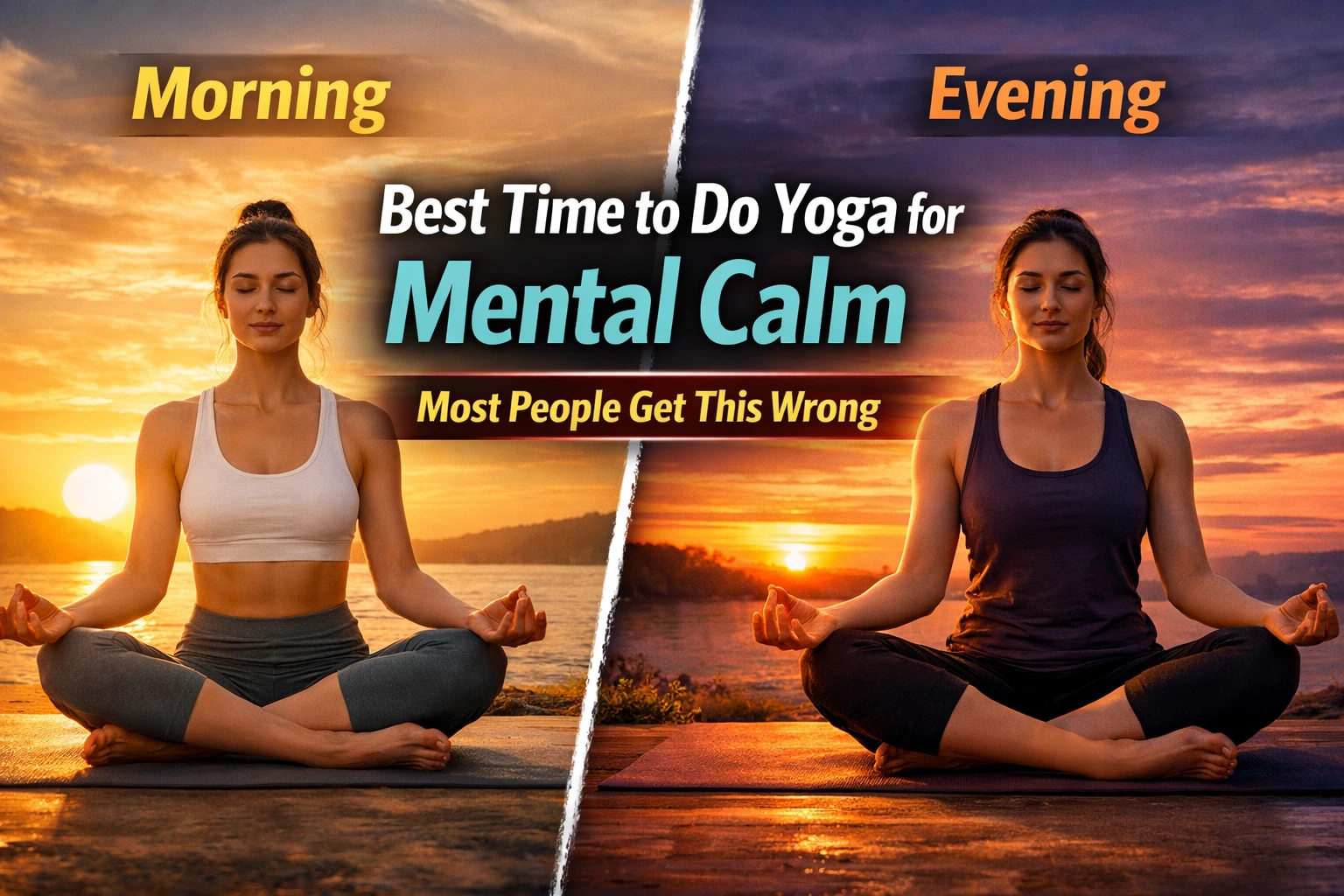
- Morning yoga helps create a stable and focused mindset for the entire day.
- Evening yoga is more effective for releasing stress and calming the mind.
- Short, consistent sessions work better than long, irregular practice.
- Choosing the right timing improves both mental calm and sleep quality.
Most people start yoga because they want to calm their mind, but when the results don’t feel the same every day, confusion begins. Sometimes after yoga, the mind feels completely peaceful, while other times, even with the same routine, thoughts don’t feel under control.
In reality, the problem is not yoga, but also timing. Your brain and body follow a natural rhythm throughout the day, and stress, energy, and focus keep changing at different times. When yoga aligns with these patterns, its effect becomes deeper and long-lasting. Doing yoga at the wrong time still works, but the impact does not feel as strong.
Why the Right Timing Supports Mental Calm (Based on Psychology and Cortisol Patterns)
People often treat yoga as flexible and do it at any time, but the body does not work that simply. Inside your body, hormones follow a pattern that directly affects your mood and stress levels. Cortisol is one of the most important hormones in this process.
At different phases of the day, this hormone keeps changing, and because of that, your mind feels different too. If you understand this pattern, the effect of yoga can improve significantly.
- In the morning, cortisol is high, which creates alertness along with slight pressure
- In the afternoon, energy gradually drops and fatigue starts to appear
- By evening, cortisol becomes low, but the day’s stress remains in the body
This simply means that:
- Morning yoga helps control early tension
- Evening yoga releases accumulated stress
- Wrong timing can make results feel weaker
What Happens in Your Brain at Different Times of the Day
It often feels like stress comes without any reason, but your brain actually follows a pattern. At different times of the day, your focus, energy, and thinking style keep changing. Because of this, the same yoga session does not feel the same every time.
If you understand this pattern of your brain, you can plan your practice better and improve your results.
- In the morning, the mind is clear but comes with alertness and slight pressure
- In the afternoon, focus drops and work starts to feel tiring
- In the evening, the body slows down, but thoughts become more active
This is important to understand because:
- Morning yoga gives direction and stability
- Evening yoga slows the mind
- The right timing reduces frustration
Morning Yoga Benefits for Mental Calm (Science Explained)

Morning time is the most important for mental setup. The pattern you set at the beginning of the day continues throughout the day.
If your start feels scattered, the whole day feels the same. When you begin in a calm state, maintaining control becomes easier. Morning yoga creates a strong impact during this phase and helps keep your mind stable.
- It gives control before stress starts building
- Focus and clarity improve
- Emotional balance stays stable
- Handling stress becomes easier
How Morning Cortisol Affects Anxiety
When you wake up in the morning, your body automatically releases cortisol. It makes you active, but sometimes it can feel like restlessness. That is why some people feel heavy even after waking up fresh.
Yoga smooths this situation and stabilizes the mind.
- Breathing helps control the cortisol spike
- Light movement relaxes the body
- Focused attention controls thoughts
Why Early Hours Improve Focus and Emotional Stability
The first hour of the morning shapes your mental pattern. If you start in a rush, the whole day feels pressured. When the start is calm, maintaining stability becomes much easier. Morning yoga is very useful in this phase.
- Attention becomes stronger
- Emotional reactions stay under control
- Patience increases naturally
Brahma Muhurta: Ancient Wisdom Meets Modern Science
Since ancient times, early morning has been considered the best for mental clarity. During this time, distractions are minimal and the mind is naturally calm. This also aligns with modern science because practicing yoga at this time creates deeper calm.
- Awareness improves
- Mindfulness becomes stronger
- Emotional balance becomes better
Evening Yoga Benefits for Stress Relief and Better Sleep
Throughout the day, small things build up stress. It is not felt immediately, but by evening it turns into tension. Both body and mind feel tired but are not able to relax.
Evening yoga releases this buildup and shifts the body into rest mode.
- Physical tension reduces
- The mind becomes calm
- The body moves into relaxation mode
- Sleep quality improves
How Stress Builds Up During the Day
Daily stress builds from small things. Every task takes a little energy, and by the end of the day, it becomes noticeable. Its impact keeps increasing gradually.
- Mental fatigue starts to appear
- Irritation increases
- Relaxing becomes difficult
Why Evening Yoga Releases Physical and Mental Tension
Throughout the day, the body and mind keep taking small loads, but this load is not felt immediately. Gradually, it builds into tension that feels heavy by evening. The body does not switch off on its own; it needs a signal to relax, and yoga helps make this transition smooth.
Understanding this process is important because relaxation does not happen automatically; it needs to be activated. Evening yoga uses breathing and slow movement to signal the body that it is time to rest, allowing internal pressure to release gradually.
- Muscles start to loosen gradually
- Heart rate naturally slows down
- The mind feels lighter and more stable
Does Evening Yoga Improve Sleep Quality?
Many people think that just being tired is enough for good sleep, but that is not true. The body may be tired, but if the mind stays active, sleep keeps getting delayed. This is a common problem, which is why people do not feel rested even after going to bed.
In this situation, evening yoga provides a natural solution. It gently relaxes both the body and mind, helping create the calm needed for sleep. When internal noise reduces, sleep starts coming naturally.
- The speed of thoughts begins to slow down
- The body prepares for rest mode
- Sleep comes naturally without force
Morning vs Evening Yoga: Which Works Faster for Anxiety?
Many people ask this because they are looking for faster results. At first glance, it feels like one timing should be the best, but in reality, both have different roles. Morning and evening yoga do not have the same impact; they handle different situations.
Understanding this difference is important, otherwise you may set the wrong expectations. Once you gain clarity about which time works for what purpose, you can use your practice more effectively.
Instant Stress Relief vs Long-Term Mental Calm
The effect of yoga can be immediate or built over time. It completely depends on when you practice and what your goal is. Each timing has its own unique benefit that works in different situations.
Once you understand this, confusion goes away and you can plan your routine better. Instead of practicing randomly, you begin practicing with intention, which becomes more effective.
- Evening yoga reduces stress quickly
- Morning yoga builds a stable mindset
- Combining both is the most powerful approach
Which One is Better for Overthinking?
Overthinking is a condition that usually activates when the environment becomes quiet. During the day, distractions keep it suppressed, but in the evening or at night, it suddenly becomes stronger and harder to control.
At this stage, timing becomes very important. Evening yoga directly targets that moment when thoughts become uncontrolled. It gives the mind a break and slows its speed.
- Evening yoga breaks repetitive thoughts
- It gradually slows down the mind
- It creates a calm state before sleep
Which One is Better for Sleep?
For good sleep, physical tiredness alone is not enough; mental calmness is equally important. If your mind stays continuously active, sleep does not come properly, no matter how tired the body is. Many people face this imbalance.
Evening yoga helps correct this imbalance. It signals the body to stop activity and move into rest mode. After this transition, sleep becomes naturally smooth and deep.
- It prepares the body for rest
- It reduces mental activity
- It supports deep and stable sleep
The Best Time to Practice Yoga According to Your Lifestyle

Every person has a different routine, so one fixed time does not work for everyone. Many people copy others’ routines and then feel confused when results do not come, or they stop completely. In reality, you need to choose timing based on your own daily life.
Consistency is the most important factor here. More than a perfect time, it matters that you can follow it regularly. When the routine becomes sustainable, long-term benefits start to appear.
- Morning works best for students
- Evening works better for working professionals
- Night-active people can prefer late practice
- Busy people can follow a short and simple routine
5 Signs You’re Doing Yoga at the Wrong Time
Sometimes the problem is not yoga, but the timing of doing it. The body always gives signals, but we keep ignoring them. When you do not practice at the right time, expected results do not come and frustration increases.
Understanding these signs is important because they guide you on whether you need to change your timing or not. Small adjustments can create a big difference.
- Restlessness increases instead of reducing
- The mind does not feel calm after practice
- The routine does not stay consistent
- The body does not feel light
- Sleep patterns do not improve
Common Mistakes That Reduce Yoga’s Mental Benefits
Many people practice yoga, but still do not get the expected mental benefits. The reason is often small mistakes that go unnoticed. These mistakes slowly reduce the effectiveness of the practice.
Yoga is not just physical movement; it is a combination of breathing and awareness. When these basics are ignored, the result becomes weaker. Avoiding these mistakes is very important.
- Doing intense practice too late
- Ignoring breathing
- Not keeping timing consistent
- Finishing sessions too quickly
- Treating yoga only as exercise
The Best Time for YOU (Based on Psychology)
The biggest myth is that there is one perfect time that works for everyone. In reality, that is not true. Your goal and lifestyle decide what works best for you.
When you choose timing based on your needs, the effect of yoga becomes naturally stronger. This approach helps you move out of confusion and practice with clarity.
- Morning is best for focus and clarity
- Evening is better for relaxation and stress release
- Combining both gives the most powerful results
Conclusion: One Simple Habit That Can Calm Your Mind Daily
Mental calm is not something complicated; it is the result of small daily habits. Yoga is one such habit that, when done at the right time and in the right way, naturally balances the mind.
Consistency is the most important factor here. When you make it part of your routine, you begin to notice gradual changes that last long-term.
- Anxiety starts reducing gradually
- Emotional balance improves
- You begin to feel more control over your mind
Start simple and stay consistent—that is the most powerful step.
FAQs:
What is the best time to do yoga for reducing anxiety?
The ideal time depends on when your anxiety feels strongest. If your mind feels unsettled early in the day, practising yoga in the morning can help you feel more balanced. If stress builds up as the day goes on, an evening session can help release that pressure and calm your mind.
Is morning yoga more effective than evening yoga for mental calm?
Both morning and evening yoga support mental calm, but in different ways. Morning sessions help you start the day with clarity and control, while evening practice helps unwind stress and relax your mind after daily activities.
Can yoga at the wrong time reduce its benefits?
Yes, timing can influence how effective yoga feels. Practising at a time when your body is not ready may reduce its calming impact. For example, intense yoga late at night may overstimulate the body instead of helping it relax.
Do I need long yoga sessions to feel mentally calm?
Even short sessions can be effective when done with full attention. A quick routine can help calm your mind and ease physical tension. What matters most is practising regularly, rather than the length of each session.
Should I do yoga every day for better mental health?
Doing yoga regularly can improve mental stability and reduce stress over time. Daily practice, even if short, helps build a routine that supports emotional balance and better control over thoughts.
Disclaimer
This information is provided for general awareness and learning purposes only and should not be taken as professional medical advice. If you have ongoing physical or mental health concerns, it’s best to consult a qualified healthcare professional.









Leave a comment